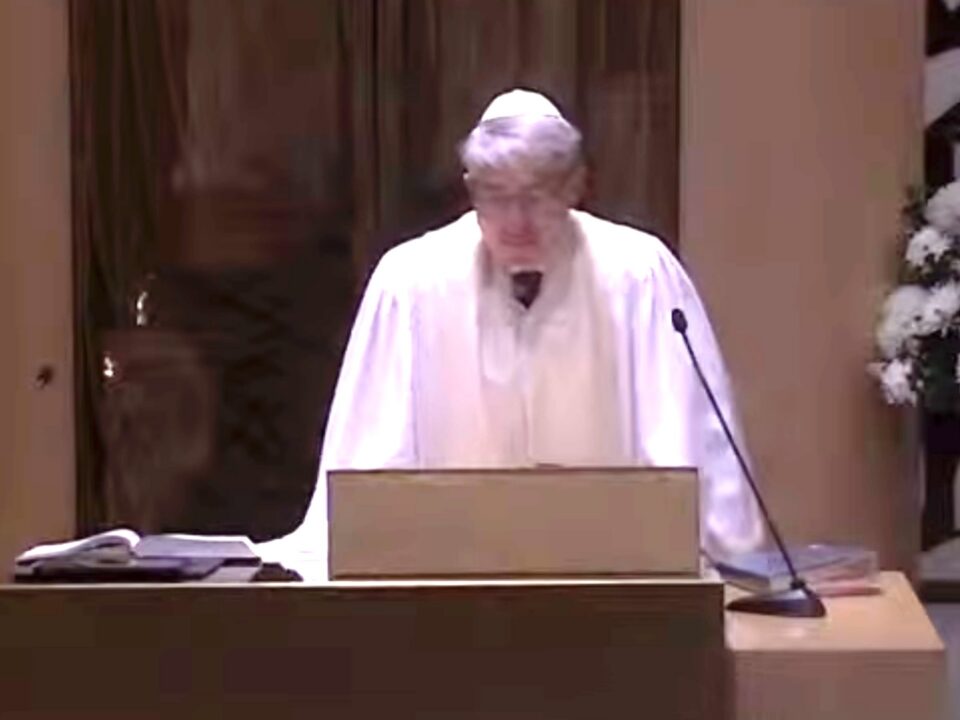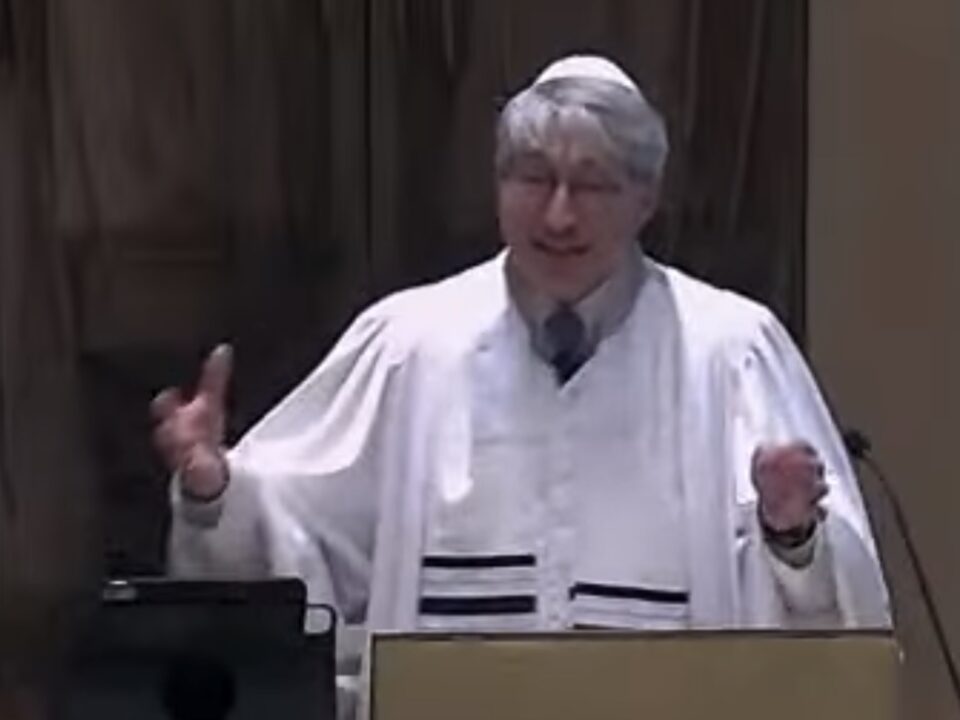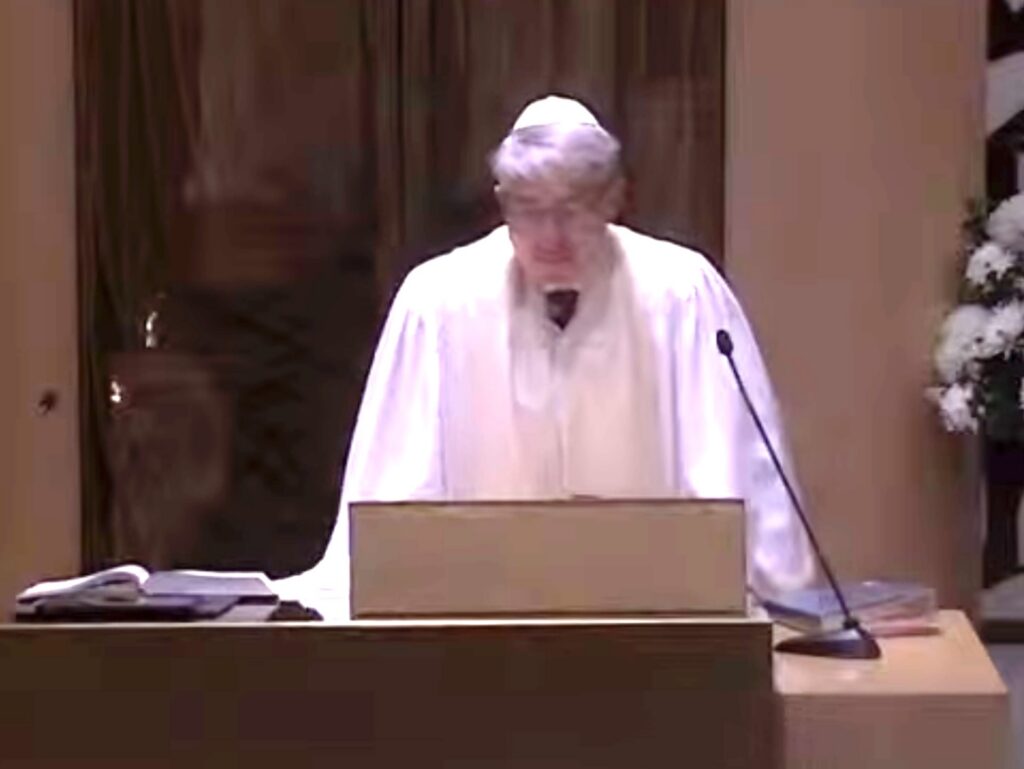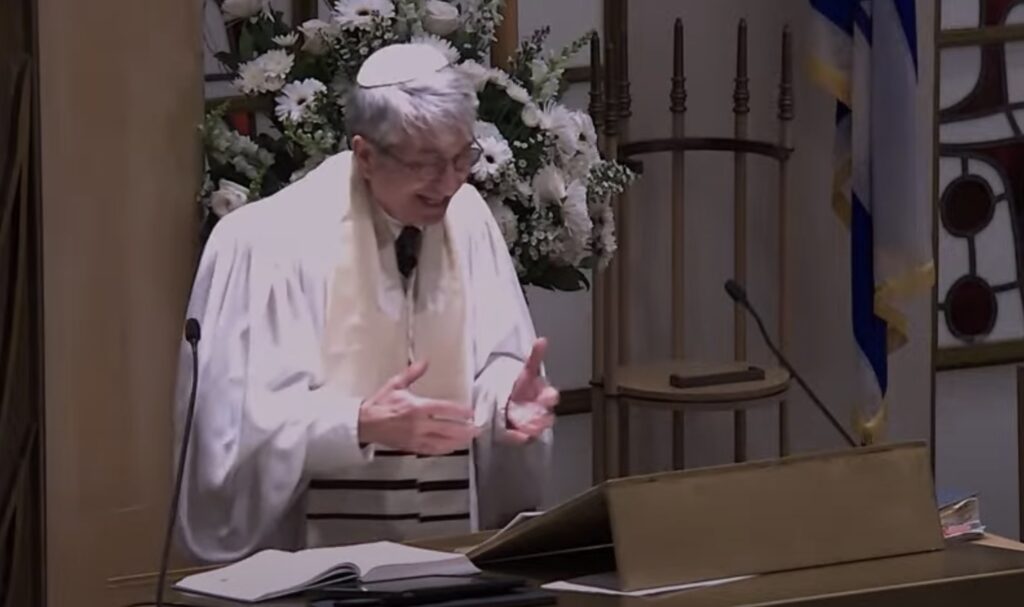
Rabbi Frankel’s Sermon for Erev Rosh Hashanah 5787/2026
September 11, 2026
Rabbi Sirkman’s Sermon for Kol Nidre 5787/2026
September 20, 2026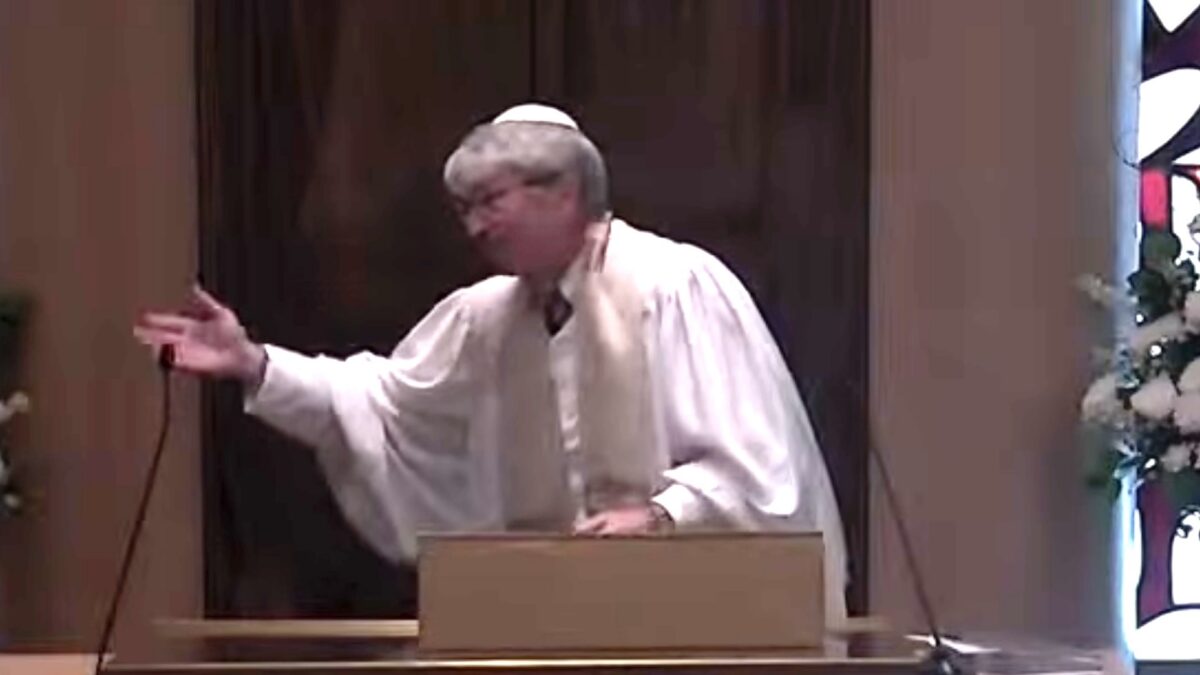
I don’t know if you noticed, but our LT L’chayim Construction has begun!
And though none of us are wearing those yellow hard hats, Or will get to test our skills on the bulldozers or excavator parked outside, what you might not realize is that, understanding ourselves as a COVENANT community, we are ALWAYS under construction, daily working to create the LT we must be, or should I say, become… Which means every one of us is part of the construction crew; the project of creating Covenant ever-ongoing.
Indeed, this very RH day, often called Yom HaRat Olam—the Day the World was Conceived is meant to transmit to us the blueprints, the re-conception, if you will, of the current building plan we need to work on to renew our world.
So, doing a little legwork, after exploring The Builder’s Association.com website which stipulates, first & foremost, “the importance of building codes in the crucial role they play to ensure the safety, functionality and integrity of the construction process,” it didn’t take me long to recognize the integral foundation upon which LT rests which has not really changed since we started, nor, for that matter, since Rabbi Shimon framed it in the Talmud almost 2000 years ago:
“Al Sh’losha Devarim Ha-Olam Omed…”
On three pillars the world stands: On Torah, On Avodah—Worship, and on Gemilut Hasadim—Deeds of Lovingkindness. [Pirkei Avot, 1:2]
But Foundations, no matter how firm, are not enough to infuse the production process with purpose. The Chief Architect puts the schematics in our hands, leaving the actual design development up to us. Metaphysically speaking, it all comes down to me and you, the construction crew.
How do those foundational principles guide us in constructing Covenant?
As many know from undertaking their own home renovation projects, Just look around town, you’ll see them all over… Every crew requires a construction manager.
So let me try to translate our architectural vision into buildable reality by reframing our foundations into updated building codes. How do our tradition’s 3 primary foundation stones enable us to confront the core challenges we face as Jews today, and in so doing, inspire our community, bound by Covenant, to reshape if not remake our world’s tomorrow.
Building Code Update #1:TORAH…
High-profile data by organizations like the American Jewish Committee (AJC) consistently show that an overwhelming majority of American Jews view antisemitism as a severe, escalating threat, with 6 out of 10 saying they encountered it in the past year. It seems not a week goes by when it doesn’t rear its ugly head. Still, with all the essential work ADL and its partner organizations do to combat Jewish hate, it may well be that the greatest danger confronting us is not from outside, but from within.
Back in February, at the 92nd St Y’s annual State of World Jewry Address, journalist and Jewish contrarian Bret Stephens gave us his read, advising: “The fight against antisemitism which consumes tens of millions of dollars is a well-meaning but mostly wasted effort,” suggesting we dismantle organizations that do this work. I shook my head in disagreement.
His counter, however, caught my curiosity. *“The proper defense against Jew-hatred is not to prove the haters wrong by outdoing ourselves in feats of altruism…It is to lean into our Jewishness…” *
That means taking TORAH seriously.
As Rabbi Stephen Abraham of Beth-El in Omaha aptly put it: *“The question beneath all others is not how to fight antisemitism. * It is why being Jewish is worth the fight.”
If what motivates our connection most to Judaism is combatting Jewish hate, Essential as that is, we are missing the point… After all, before we stand up to defend what Judaism is We must know what Judaism stands for…And so, it was telling…
When the founder of the Blue Square Alliance Against Hate was given the Changemaker Award at ADL’s Never Is Now Summit this past March, recognizing his organization’s impact—[How many recall the Blue Square’s Super Bowl Ad with the short Jewish High School kid confronting antisemitism walking down the hall and the taller African American teen standing in solidarity, discouraging his Jewish friend’s violent response?…]
Accepting the award, I witnessed Robert Kraft [Yes, owner of my New England Patriot’s] do something surprising, and essential. Quoting the Prophet Zechariah from his BM portion,*“Not by might and not by power” * Kraft proceeded to share his own Jewish story, his “Torah.”
How his father Harry, a local Jewish community leader sat together with others in their modest living room in Brookline, Mass and in the early 1940’s organized, standing together, build alliances…Indeed, Kraft made the lesson clear, growing up in a home rich in Yiddishkeit, part of a tight-knit Jewish community, he learned to live his values: that leadership is taking responsibility, not being afraid to speak out, to be who we are. It all starts, of course, with knowing our story.
Which is why Dara Horn’s current project underscores what the Building Code of Torah is truly all about.
Our LT fall scholar just a few years ago, here to talk about her then recent work: People Love Dead Jews, Horn was often met w/a question she was unprepared to answer: *So, WHAT is the solution? *
A dead, powerless Jew is perfectly fine. Worthy of a good memorial. An empowered, purposeful & proud Jew, a problem.
As she debated between the positive approach—teaching people about Jewish life And the negative approach—teaching about antisemitism to fight Jewish hate, Horn came to realize they are inseparably part of the same story, our story.
As she puts it:
“The story of Jewish nonconformity… The story of a tiny group of people whose groundbreaking ideas shaped world history… Judaism, the anti-hierarchical, anti-tyrannical movement based on an ancient tale of liberation which taught the world that change is possible—a movement built on laws, debate and civil discourse which taught the world that freedom requires responsibility.”
So, Dara Horn founded The Tell Institute, a double entendre, Named for the TEL—the archaeological hill that conceals layers of civilizations, And the TELL—the telling it like it is that reveals the truth behind pre/misconceptions. aiming to open minds about the foundations of the Jewish story, as the basis of our pluralistic, democratic society…Thus, revealing what she calls the “Big Lie of antisemitism,” perpetuated by rulers, past and still very much present, upset at our radical Jewish proposition that independent thinking and equal justice are the rights of all.
Horn’s key takeaway is meant for us today: “The opposite of Hatred isn’t love. It’s curiosity.”
Thus, the Building Code Update for Torah, simple as it sounds, is to tell our story, Which means first we must know our uniquely Jewish story, The Five Books of Moses, but far beyond…The sacred texts, the tales, the spirited arguments, the spiritual insights, daily wisdom and other-worldly dreams that make us who we are.
Not the take antagonists impose, but the understanding that comes from covenantal Jewish Learning: Confronting texts that confound & challenge us, tales whose multiple meanings demand we go deeper thereby revealing Torah’s secret: The Story never stops.
For as we learn it, debate it, teach it & tell it, We become part of it. And, as we do, we see ourselves for who we truly are: Grapplers for life-guidance, often with more questions than answers.
In a world where falsehood often seems to win the day, masquerading as meaning, we must be unceasing seekers of truth—that is our Torah.
Building Code Update #2: AVODAH…
Where does self-imposed solitude lead? Don’t answer that, because we already know…
How many of us are shocked when our phones give us the average daily screentime for the week and it reads: 3 hours, 27 mins. Up 12%…!
Beyond the health dangers decreed a few years back by our surgeon general about “the loneliness epidemic,” our daily choices reinforce what Federal Reserve research economist Enghin Atalay called a “century of solitude.”
Home life, with all its built-in comforts, is geared to keep us there. We binge-watch rather than get together for that BBQ. We Zoom instead of talking side by side in the living room. Amazon takes 177 orders per second. That’s 9 million deliveries a day. Why go out into the real world and get it yourself?
A couple of years ago Princeton Sociologist Patrick Sharkey published a paper he called “Homebound,” comparing data over a 20-year period, finding that Americans today are much more likely to take meetings from home, work from home, be entertained from home, eat at home, even worship from home.
And in this digital age of rapid technological advancement, AI makes it all the easier. Chatbots writing a school paper seems like child’s play when compared to the ever-increasing role played by AI in simulating emotional intimacy. 20% of young adults turn to AI for mental health advice, AI researchers project that in a decade’s time, when it comes to care, daily interactions and companionship, Artificial Intelligence will provide the average human with more than 50% of their perceived needs.
That 2013 sci-fi romantic drama, Her, where Theodore Twombly develops a deep relationship with Samantha his AI operating system isn’t quite fiction anymore.
And with the sheer speed of technological innovation the seduction finds its way all the way to the sacred.
Bay Area Pastor Justin Lester has an AI Avatar, his “digital twin” that parishioners can speak with about their problems when he’s unavailable.
Former Google AI engineer Anthony Levandowski went as far as filing all the IRS paperwork for what he called Way of the Future, An official AI worshipping religion. As he put it, “AI will effectively be a god…not in the sense that it makes lightning or causes hurricanes. But if you create something a billion times smarter than the smartest human being, what else are you going to call it?”
Substituting artificial interaction for some higher reality we are removing the key Avodah component, Jewishly speaking, which I believe leads to the Divine.
So let’s do an Avodah Building Code assessment.
Think of your favorite Jewish memory…a moment when “doing/being Jewish” brought meaning to your life, touched your heart, spoke to your spirit…[wait 3 seconds]
Now let me ask: Did anyone’s Jewish moment happen by yourself, alone? I’m betting, to a person, the answer is no…
You were with family around a table, or in the living room, or the kitchen, in a sanctuary, in a classroom, at a conference, or at a graveside, maybe shouting at a rally, or singing ‘round a campfire, joining voices in harmony or standing at the Wall. Holding hands—linked in heart—with someone you love or hardly even know.
That transcendent connection, human beings in all their uniqueness Beyond everything that makes us so different, feeling a bond not the least artificial, rather awe-inspiring, is what AVODAH is all about…
IF only the world was a soccer pitch!
Though before this past summer, European Football was not high on my list, The takeaway from watching the World Cup was nothing less than covenantal.
Exciting/exhausting, it’s what happens immediately after the game that matters most. Jubilant winners celebrate their teams exuding national pride, hugging fellow players and connecting directly with fans in the stands. Unlike any sport I’ve ever seen, offering gratitude as if cheering fans somehow made the difference….Then, something remarkable, even sacred happens.
As members of the losing squad release their emotions, many overtaken by tears, players on the winning team console them. Some, regular season teammates, others simply appreciative/respectful of their Herculean efforts, suddenly transform from the opposition to understanding compatriots.
Transcending personal triumph, beyond the team jerseys which divide them, They affirm the gift they share in just playing. And in so doing, they remind all of us, watching that despite each side’s hope of emerging the victor, they are in it together… Their ultimate aim transcends the game!
This year’s commencement address at Harvard [or as we say it in its native tongue: HA-VID] was delivered by Noah Eckstein whose words gave us something I think even he did not intend: a glimpse of God. Teasing that his family background was a great set-up for a joke, The proud Jewish grandson of an American Presbyterian, a Pakistani Muslim And a Holocaust survivor, he explained that if only seen through our increasingly divided world of taking sides and pointing fingers, his family would not exist.
“Of course, there were many differences my grandparents never resolved. But still, they acknowledged each other. They cared for each other…Yet somewhere between their generations and ours, something shifted. The noise got louder…People speaking without listening…People debating not to learn, but to win…Somewhere along the way, the person sitting across the table stopped being a person and became an obstacle…[so his challenge] “In this increasingly troubled and divided world…when you meet someone you disagree with, state your case. Stand up for what you believe, then ask them about their beliefs. Ask them how they got there…Listen like you might be wrong…”
The Building Code Update for Avodah, for the many of us who love to win an argument, is somewhat counterintuitive.
Serving God is seeing one another, not necessarily agreeing, but acknowledging, Flawed humans that we all are, beyond the reach of any artificial alternatives, we don’t have all the answers. Which is precisely why in this conflicted world we so need one another. For with allowance for team traditions a given, we must celebrate our interdependence—the AVODAH infrastructure that makes us wholly different, and each/every one of us holy, nonetheless.
Building Code #3…
The central argument played out at this past June’s third annual Recharging Reform conference at Stephen Wise Synagogue in the city, helps Clarify our Building Code update for Covenant’s third foundation stone GEMILUT HASADIM…
Literally translated as deeds of loving kindness, the catchphrase that captures its central task is TIKUN OLAM—Repairing the World.
Popularized in modern Reform by spiritual leaders pivoting to embrace the 1960’s Civil Rights/anti-war movements as part of our universal mission, Tikun’s debut in our Aleynu prayer [2,000 years ago] had little to do with us. Rather, it was an appeal to the Almighty to strike down paganism uniting the world through worship of God alone. You know, “On that day…God’s Name shall be One.”
And though 16th century Jewish Mysticism, Lurianic Kabbalah reframed Creation, suggesting that sparks of Divine Light were scattered in the world’s darkness, waiting for us to find, our role as agents of repair did not crystalize until post-Holocaust theologians, thinkers like Rabbi Harold Schulweis, sought renewed hope in this broken world, insisting that “we are allies of God who must cultivate our social conscience [in particular] and moral freedom[universally] in repairing the world.” [“The Place of Tikun in American Jewish Life,” J. Krasner, 2013]
So, Recharging Reform’s argument takes center stage. In one corner, Rabbi Ammi Hirsch’s critique: “A Jewish universalism unmoored from particularism is just universalism of the non-Jewish kind,” a put the people Israel first attitude.
And countering, in the other corner, Rabbi Jonah Pesner, URJ-VP, head of the RAC, And Rabbi Josh Weinberg, URJ-VP, head of ARZA, insisting: “The covenant that binds us to the land of Israel was never separable from the covenant that binds us to one another to do justice…A Judaism that abandons either its particularistic love for our people or its universalist commitment to human dignity is not Judaism at all.”
With Rabbi Hirsch leaning into the particular & Rabbis Pesner/Weinberg the universal, To varying degrees, both land on the fact that we must live in the tension to affect the tikkun that just might transform human reality into that heavenly dream…
So, although we need not choose between our commitment to one another as Jews and our dedication to the rights of all people, to create Covenant & make repair real, we do need to remember where the call to build a better world comes from to begin with…
In the 1989 film, “Field of Dreams,” Ray Kinsella [aka Kevin Costner] listens to the mysterious voice that disturbs his sleep, cutting down part of his Iowa cornfield to build a professional baseball diamond, upon which appears the unjustly banned [and now long-deceased] 1919 Chicago White Sox to play the game they love.
But even after the field itself is finished, Ray still hears that voice: “IF you build it, he will come.”
Seems it wasn’t a whole ‘nother team that field was meant for, but Ray’s own father from whom he was so detached during his lifetime. Now, somehow young again, his Dad an aspiring pro ballplayer, face-to-face with his long-lost future son, generations link as dream & reality merge.
If we want to truly understand world repair, the movie’s last scene is essential.
Walking at dusk on that sacred sod, an idyllic moment, Ray’s father John turns & innocently asks: “Is this Heaven?” To which his son Ray replies: “It’s Iowa.”
Ray then wonders aloud, “Is there a Heaven?” You’d expect his deceased dad to reveal some secret on the afterlife But instead reveals the secret of this life: “Oh Yeah. Heaven is the place where dreams come true.”
As Ray looks around, the camera pans to his wife and daughter laughing on the porch swing, his home, the field—and with his Dad so close it feels like a dream, he finally admits aloud, “Maybe this is heaven.”
Sappy, sentimental, surreal if not magical, over-the-top hopeful, Just this is Tikkun Olam’s ultimate truth: The world is broken—so many people in far too many places. The task is gargantuan. Most days it feels like our efforts are futile.
Thus, our Building Code Update for Gemilut Hasadim, reminds us: Repair calls us from our little corner, our family circle, generations long gone but still whispering…We don’t fix the world in a flash. It begins with our field, what we can do right here and now, with available means, light and might. We make redemption real by starting small but always dreaming big. After all, “IF you build it…”
My father would be one hundred years old this November. But Herman Sirkman, Herbie, died at just 57, 9 days after Susan and I returned from my first year at HUC in Jerusalem. I was 24.
Battling cancer the entire year, my family decided not to let us know, thinking, Jeff & Susan are doing so well. Its his dream to be a rabbi…and if they come back home, without the means to get back to Jerusalem, well…who knows.
The frail, hobbled man we met upon our return is not the Dad I remember. In my eyes, my father was larger than life.
Not because he was an ideal husband. My parents divorced when I was turning 16. Not because he was an exemplar of Jewish tradition. My Dad came to HH Day services, mind you, we lived right next door, Perfectly timed to miss the rabbi’s sermon.
But because in his small circle, The man everyone in the diner knew and seemed to love, who treated every person he met like a best friend. The guy who’d go out of his way to help anyone in need, The son so dedicated to his parents [my Bobba & Solly] he bought a two-family home And immediately moved them in downstairs, The Dad who’d have catch with his budding baseball all-star in the front yard even after a very long day at work…Thoughtful, good-humored, kindhearted, without the means yet still giving us, me & my sister Rhonda so much, Herb Sirkman, though he’d be shocked to hear it, was unquestionably on God’s Covenant construction crew, because he knew: life is about the relationships we nurture with human curiosity ever open for a conversation… with hands ever ready to help, even get a little bit dirty, with a heart open to anyone hurting.
My father inherently understood—as do we: You can’t construct Covenant with bricks and beams. We build it with the tools we constantly carry, innately implanted:
The tales that tell our story, *our truth–*TORAH
The humanity that links *our hearts–*AVODAH
The promise that sparks our hope—G’MILUT HASADIM
This New Year, with blueprints in hand realizing we are building a world every day under construction, May our commitment to the Building Code we call COVENANT help us make this earth feel a bit more like heaven, a place dreams just might still come true…
AMEN