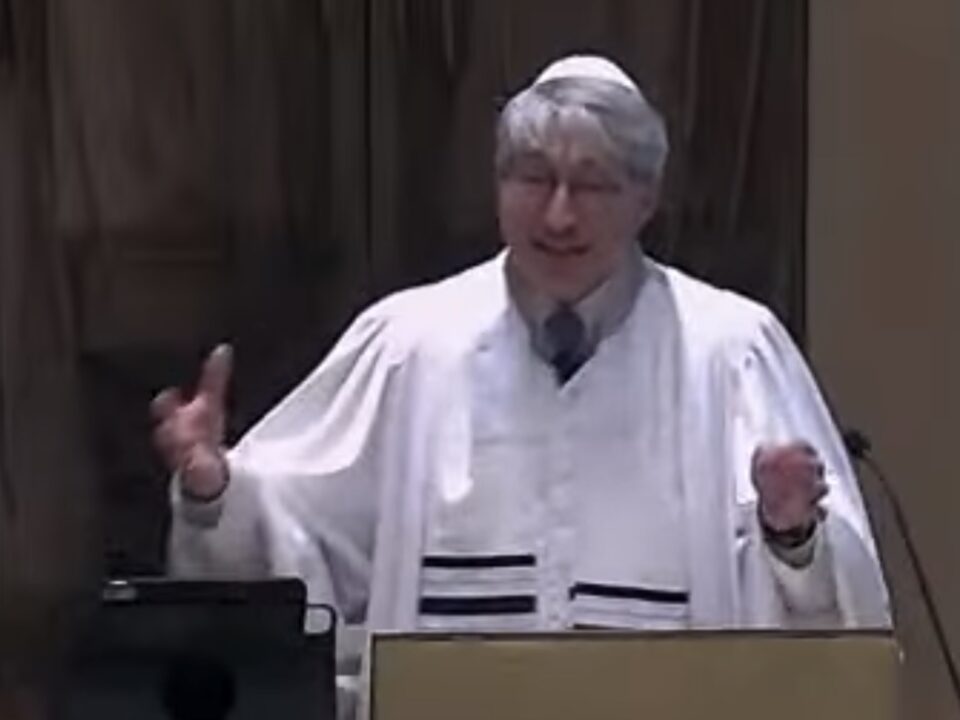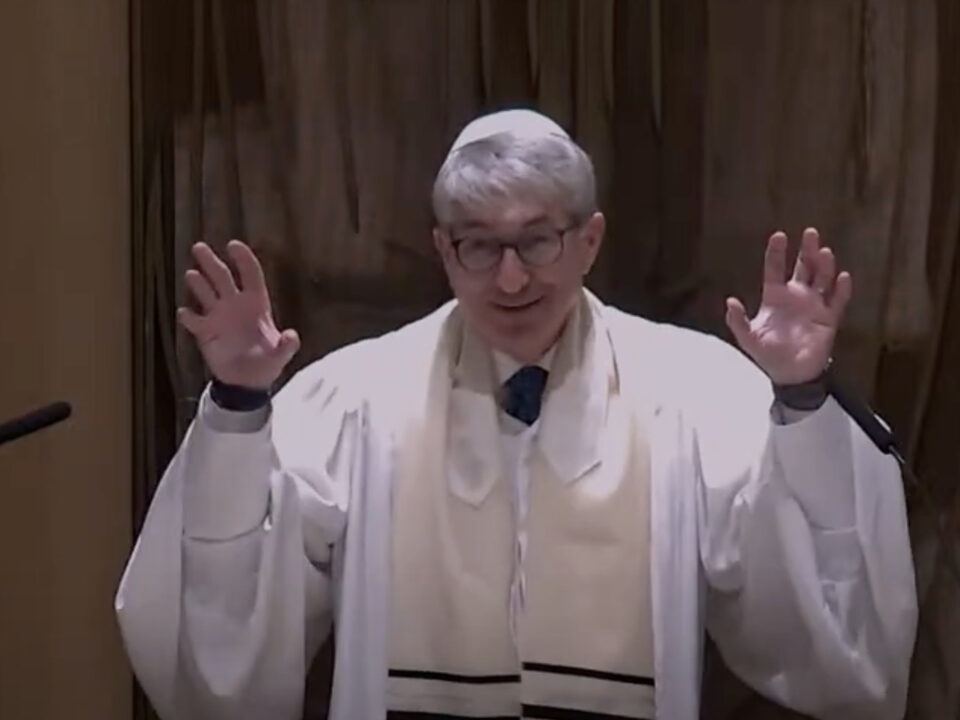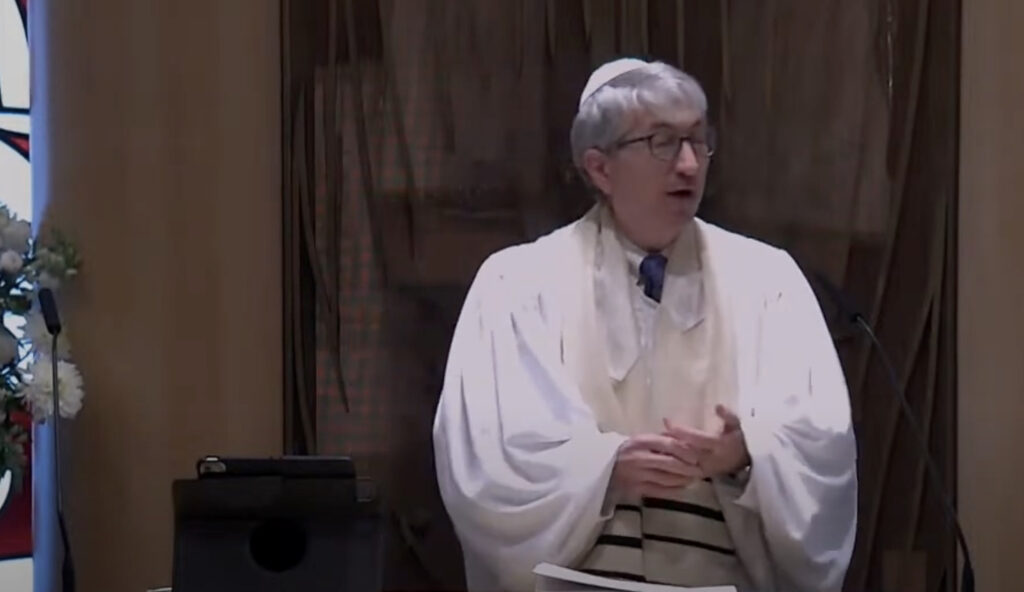
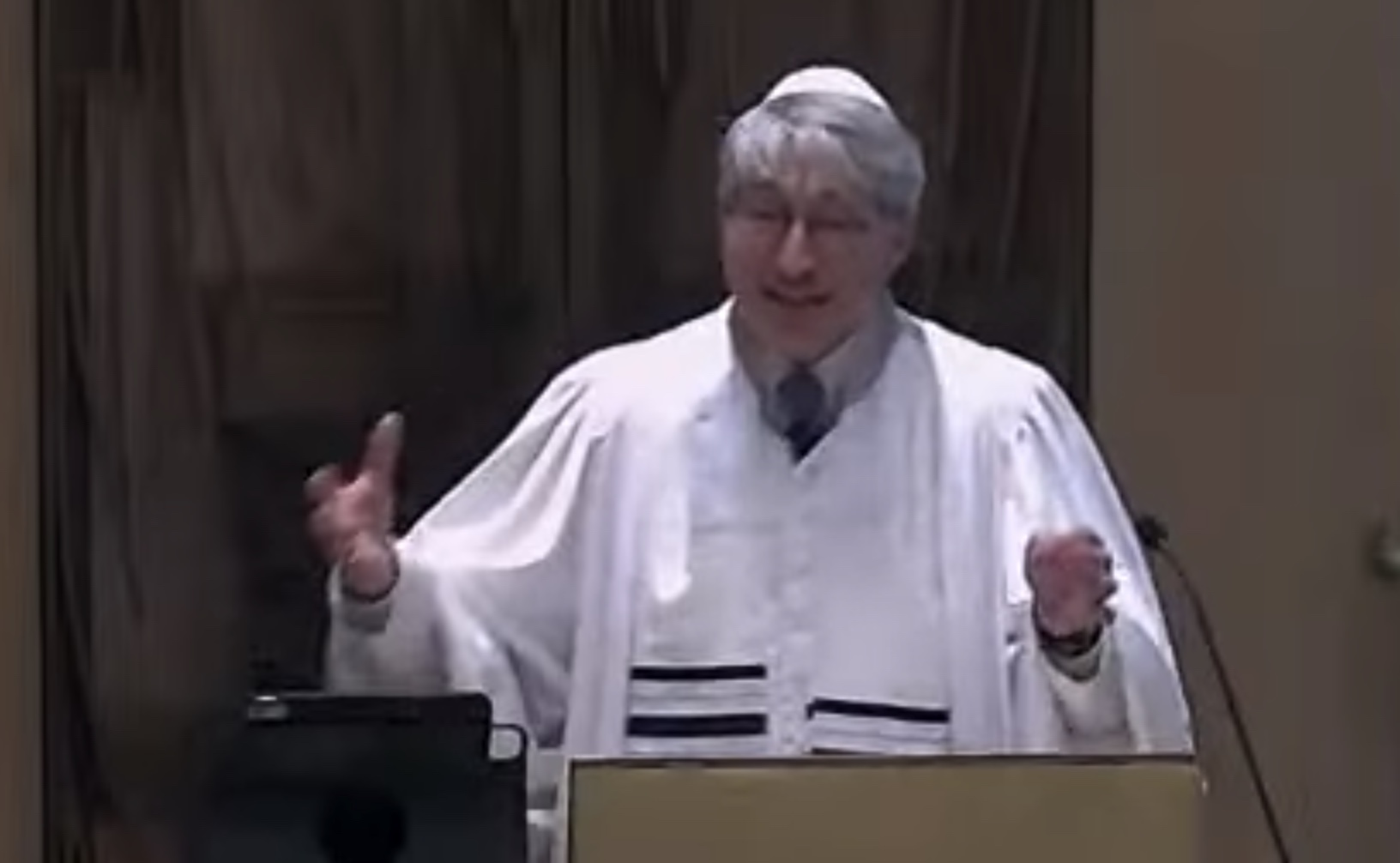
Rabbi Sirkman’s Sermon for Rosh Hashanah 5786/2025
September 25, 2025
Rabbi Frankel’s Sermon for Yom Kippur 5786/2025
October 6, 2025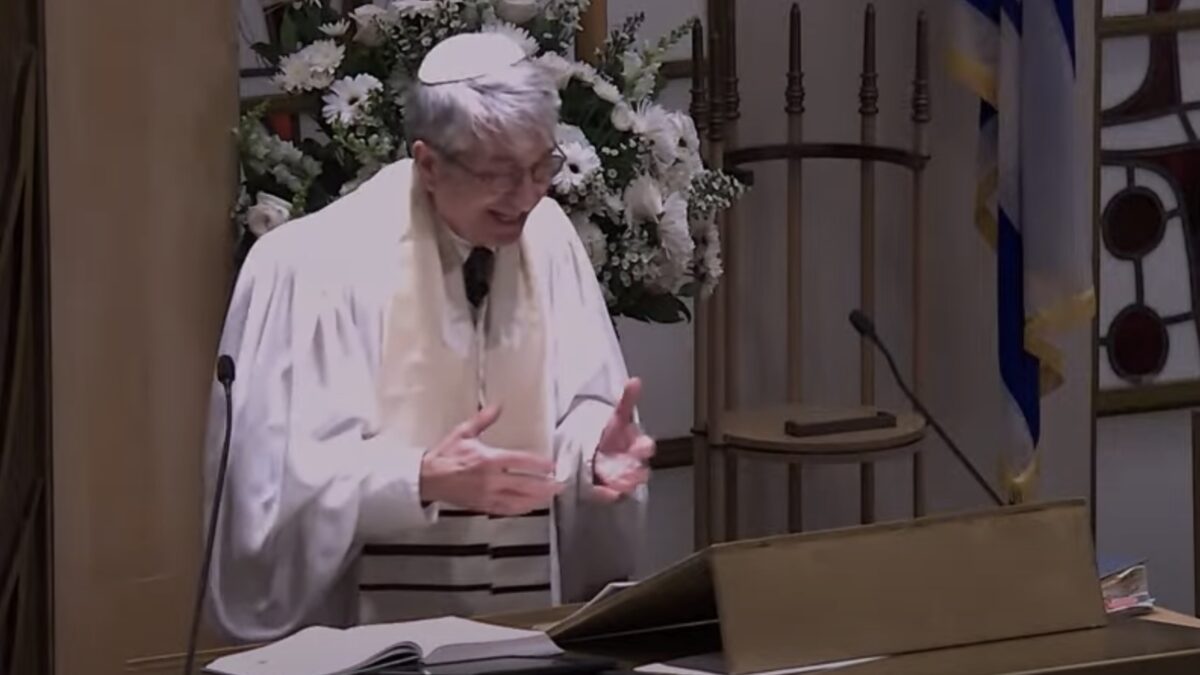
HIGH Anxiety: Choosing HOPE
LT Kol Nidrei, 5786
In retrospect, my most impactful teacher in rabbinic school was not the one whose theories transcended but whose humanity touched my heart. Master of Medieval Jewish philosophy, Dr Leonard Kravitz, who died this past November at 96, taught Maimonides’ Guide for the Perplexed, but what he really imparted to us, often conveyed through his beloved Yiddish catchphrases, was Jewish Life Wisdom—how to deal with a difficult/challenging world.
I can hear him responding to whatever crisis or conundrum we were confronting, answering with the simple 4-word classic: “SCHVER ZU SEINER YID—It’s hard to be a Jew!”
You could tell from his delivery that Dr. Kravitz was not summoning some 18th century Fiddler on The Roof downtrodden, oppressed people mindset. Conveying the message with a wry smirk and a sigh, in just four Yiddish words, Dr. Kravitz was reminding us of our people’s purpose, In effect saying: IF being who you are is easy, then you are not who you think you are, nor all you should be!
Channeling my teacher, the question echoes especially tonight: “So, Nu, Yidden; WHO are we?”
In his bestselling book of 1962, The Art of Being a Jew, a collection of short essays on who, why and how we are, Rabbi Morris Kertzer, national Jewish leader, speaker, teacher and at the time, rabbi of this congregation, answers the question in his introduction:
What is Judaism, really trying to say to us?… Judaism is neither a body of doctrine nor a theological discipline but a way of life—or, even more accurately, a way of looking at life!”
Tonight, as the Holy One holds up a mirror, beginning the 24-hour journey that helps us see our best selves, empowering us to see our world and do what we can to get things back on track…
The challenge feels immense. Everywhere you look, all you see is TSORIS! Democracies often feeling like autocracies, wars proliferating, nationalism hyper-extended…Strongmen overreaching.
Due-process disregarded…Human life marginalized First Amendment rights subjugated. Science subverted. A justice system weaponized…Higher education imperiled. Church-State separation eroding…Our planet’s resources imploding.
And, saving what could be the worst for last, all of this as antisemitism is not just increasing but intensifying, more prevalent, more prominent than many can ever remember.
How many of you, like me, look at your morning newsfeed, or newspaper, with admitted angst, some days dread, thinking: Really! What next? HOW can we keep from seeing all this worry & woe, all the tsoris surrounding us, and feeling so emotionally exhausted, so unsteady on our societal feet, so overwhelmed, even helpless, that all we can do, the most seemingly sane thing to do, is to simply look away.
Summoned to serve, Jonah jumped ship, trying to head in the opposite direction from where the Holy One needed him most. Sure, it’s hard to be who we are…but does it have to be this hard?
In Miami for a couple of days at the beginning of June for my grandson Sawyer’s graduation from Temple Judea Nursery School, scrolling between the fire-bomber attack on Jewish peace activists in Boulder and the 20 Palestinians killed at a new Aid Distribution Center in Gaza, with my second cup of coffee failing to calm me down, and with a couple of hours to kill, I walked to my favorite Barnes & Noble in S. Miami to lose myself in the shelves and browse for a bit of relief.
Not 5 minutes passed when, staring me in the face, I found my solution, [or so I presumptuously thought] Brigid Delaney’s Reasons Not to Worry. “Being human right now,” she writes in the Preface, “feels like being blasted with a high-pressure fire hose…It is just too much, it often seems, to open our eyes.” And the Australian author’s answer for finding meaning in a world gone mad? The ancient Greco-Roman Philosophy of STOICISM!
Having spent a week living a ‘Stoic Life’ for a column she wrote in The Guardian, Delaney was so intrigued by its promise of a new, healthier way to see the world that she undertook a two-year study-life immersion…Far from what some might regard as simply an internal character trait, Stoicism articulated a unique life-attitude, in essence, she explains, a clear-eyed perspective that, recognizing a difficult reality before us, admitting no savior from on high will rescue us, puts the onus on us…as we strive to be virtuous, rational, mindful human beings.
Sounded good so far, but reading on, I realized the major problem with Stoicism’s life proposition…Since large-scale systemic change is not our direct responsibility, our focus, Stoicism says, should be limited to our own personal sphere of influence, our concern only those things we can impact directly…
As the author puts it: “If you can’t control something, you need to accept it, thereby regaining inner equilibrium, a sense of balance in a time of uncertainty, overcoming your passion, letting go of what’s beyond your control…coming closer to achieving tranquility.” [Reasons Not To Worry, pgs. 102-107]
Then, as her prooftext, Delaney quotes the Roman Stoic Seneca, who wrote: “IF you wish to put off all worry, simply cease to hope, and you will cease to fear.” [Reasons Not To Worry, pg.258]
OY…! I’d already bought the book and written in it, so I couldn’t return it. But how Un-Jewish can you get Our whole purpose as a people is that we are here for a reason: To see the world in all its woe, and to somehow know, it IS our responsibility! Teshuvah, turning ourselves & our world around, is, after all, the order of the day. Facing the brokenness, we are here to make it better…or at least, to try.
The question remains: HOW….
What drives our determination? What moves us to see the struggle with open eyes—open hearts, and to summon the strength of spirit, to find the fortitude to stand up and somehow respond…
Strange as it may seem, in a word: ANXIETY!
Not meaning to minimize, God forbid, the debilitating disorder affecting more than 25 million Americans, often coupled with depression, making it nearly impossible to fully function, but rather what I’d respectfully call High Anxiety, felt by so many, confronting a wanting, worrisome world and refusing to look away.
The great Reform thinker whose Covenant Theology frames LT’s mission, Rabbi Eugene Borowitz, was himself “motivated by one of the perennial catalysts of Jewish imagination: Anxiety.” As Rabbi Michael Marmur, Prof. of Jewish Thought at HUC in Jerusalem understands: “Borowitz was one of a long line of Jewish worriers. As we know, in Jewish civilization, anxiety is a spur to creativity.”
Feeling anxious about…[almost everything?] Good.
For that is the lens through which we must see our world.
And if we don’t, can’t or won’t?… As Marmur cautions, “There are people who insist that they’ve found some secret allowing them to rise above it all and leave anxiety behind. I wish them well…But to be self-satisfied in the face of humanity’s many challenges may bespeak not spiritual excellence but self-delusion…” [Living the Letters: An Alphabet of Emerging Jewish Thought, M. Marmur, pgs 2-3]
And you thought our services were meant to bring serenity? Think again! No one frames our people’s anxiety-driven purpose more forcefully than master Talmudist, brilliant-out of-the-box thinker, Rabbi Adin Steinsaltz.
Full disclosure…I used to use the 5-page essay I’m about to cite as my intro session for the 5th year rabbinic & cantorial Senior Seminar students I teach at HUC, until around 7 or so years ago, when several of them were so bothered by its premise they revolted…I hope YOU won’t!
Positing that ‘Peace of Mind,’ Jewishly speaking, is way overrated, Steinsaltz affirms the supreme value of inner strife: “Ongoing struggle between the given, present reality and that which has not yet come into existence…is the root of our being.”
In short, our anxiety with the present is the prerequisite to actualizing our Jewish purpose. What goes on in here and what transpires out there are inextricably intertwined.
“Man’s struggle,” Steinsaltz explains, “is part of the larger process of life itself—in cosmic terms, between chaos and creation…The choice between good and evil is preceded by an even more fundamental choice: Whether to give moral expression to the contradiction inherent in our humanness, or to try to ignore it.” [“To Strive Toward Spirit,” Steinsaltz, Parabola Magazine, Fall, 1996]
After all, how’d that steerage ticket work out for the reluctant prophet?
Life in the belly of the whale notwithstanding, when the world’s tsoris hits you in the face, you can only flee so far!
“SCHVER ZU SEINER YID “
As human beings whose hearts are daily broken by the world, what keep us from looking or running away?
Anxiety may inspire the struggle, but where does it all lead?
Rabbi Gordon Tucker knowingly teaches, To our ability to see what is not yet there. Noting that, according to the Babylonian sage Rava, [Shabbat 31a] everyone is asked 6 questions on the admission ticket to God’s Kingdom. In the great hereafter, Rabbi Tucker notes that the last question is the true measure of life-wisdom. “Were you able to intuit that which was only implicit before you?”
Explaining with a verse from American poet Wendell Berry’s “The Peace of Wild Things,”
“When despair for the world grows in me
And I wake in the night at the least sound,
In fear of what my life and my children’s lives may be…
I come into the peace of wild things…
and I feel above me the day-blind stars,
Waiting with their light…”
“That,” Rabbi Tucker teaches, “is what gives us the confidence and assurance.
That what we need is always waiting…Rather than an escape, the poet is recommending the cultivation of lenses that frame a new life-prescription. [“Beyond What is Present,” pgs. 264-5, G.Tucker, Festschrift for Les & Benjie]
And wouldn’t you know it, that lens on reality is our people’s operating mode: We call it HOPE… That even in the darkness, the most difficult moments, facing the most intractable problems, the light is always there…
But as Jews we have to know how to generate that otherwise unseen/hidden light.
In Hebrew, TIKVAH, from the root K-V-H, means “thread” or “rope.” Hope is the rope each one of us hold onto…the lifeline that, beyond our anxiety, our struggle with the world as it is keeps us holding on to a vision of the world as it ought to be. It likewise keeps us from falling off the deep end of despair, keeps us standing up to intolerance, calling out indifference, because in taking hold of that rope called hope we are holding each other up…
I had not seen nor heard from Joe virtually since he became Bar Mitzvah on a wonderfully intimate Israel trip, mostly his family and 8 or 9 other LTers, along with me and Susan, 14 or so years ago…Back then we called him Joey…
His unexpected email prompted a let’s have coffee response. So, in to see his grandparents, in mid PHD work at the Univ of Chicago, we met late August to talk. He opened the conversation: “I have such a heavy heart…”
Joe went on to describe his struggle, a deep concern for Israel and an equally deep disconnect with its ongoing war in Gaza… He spoke about wishing he had a more nuanced Jewish education growing up, inculcating a love for Israel and a compassion for all peoples. He shared how difficult it is to find others in his generation willing to engage. And he told me how grateful he was, even after all these years, to have a rabbi he knew he could come home to…
“You know, Joe, I may not have the answers but I share many of your questions.”
“But you know, Rabbi Sirkman,” Joe said smiling sweetly, “not to put the pressure on, but there are a lot of people waiting to hear what you have to say…”
It was that moment I wish I’d said to him: “The courage to keep struggling, striving to make the world more just, more true, is in knowing I am not in it alone…Even with all your concerns & questions, coming here to be enlightened, the light of hope Joe comes from you!”
“Judaism,” wrote Rabbi Jonathan Sacks, “Is the voice of hope in the conversation of humankind.” The Greeks believed in fate, the future determined by the past. The Jews believe in freedom, the future determined by how we respond in the present. “The Greeks gave the world the concept of tragedy. Jews gave it the idea of hope.” [“The Birth of Hope,” R’ Jonathan Sacks, B’Chukotai, 5779]
We think we’re here, as Torah demands, to Choose Life. But in our meshuganeh world today, that is not quite enough. Staring life in the face—all the fractured, forlorn people, in so many broken places, our aim is to see what is not yet there, a light concealed until another struggling soul comes along, and dares to share a picture of possibility of what just might be…of how life could be different, better, crazy to imagine, even blessed…
Ma’oz Inon, entrepreneur whose parents were murdered on October 7th teaches: “Hope is not a feeling that I wait for…Hope is a communal endeavor, something we create together.” [Marmur, Intro, pg.10]
For those so burdened by the distress, the despair of their present, that they cannot manage to even see beyond it… For those who cannot bear to be witness to any more suffering, who cannot help but look away… for those of us feeling overwhelmed by it all, feeling so small, as if our impact would hardly make a ripple of a difference… we must know, being together tonight makes visible a light that illumines a world yet to be, that is, if we can see it in one another.
Climbing above our complacency, struggling in our sacred discontent, imagining beyond our anxiety, that light shines when we kindle it through our care…
Responding last month to the hellish school shooting at the Annunciation Church, killing two children, wounding 17 others gathered for morning prayers, by a former student filled with hate, Minneapolis Mayor Jacob Frey explained that VP Vance misunderstood what he meant…
“I’m all for thoughts & prayer” Frey said, “but…in Judaism there’s a principle known as Tikun Olam, Healing the World…Prayer is only adequate if you can attach an action to it, if you try and do the work…like passing the very necessary legislation that prevents kids from dying and saves lives in the future.”
Jewish Hope is not about dreaming, it’s about doing.
In his Meditation on Hope [delivered at FAU in March, 2003] Prof Elie Wiesel underscores the power we possess:
“Blossoming at the paradoxical moment when its absence is stronger than its presence…HOPE is a transcendental act which accompanies us in all our endeavors, allowing us to go beyond our limits so as to enter an uncertain future…Just as only human beings can push me to despair, only they can help vanquish it, and call it hope.”
For the Stoic, hope is a fantasy with no basis in reality. for us, hope is our commitment to a reality just waiting to happen…
Yes, “SCHVER ZU SEINER YID “
You bet it’s hard to be who we are—hard, because it’s holy…
Facing centuries of Tsoris before us, if our ancestors responded with despair, we might not be here… We dare not deny the darkness. We feel the human heartache… And as some attempt to extinguish the sacred spark inside us, compelling our human outcry, we mustn’t fail to see, to be the light.
Holding on to Tikvah, in spite of everything, heart to broken heart, with struggles unceasing & tsoris aplenty, holding each other up, knowing we are in this maddening world together, our options limited and life hanging in the balance, make no mistake, we are here to CHOOSE HOPE!…
With the Holy One of Being hoping that we do…this new year, so may it be…AMEN